How variation rewrites RNA, and how we can rewire it to treat disease.
We use computation and genomics to understand how genetic variation shapes gene regulation, with RNA splicing at the centre, and we study small molecules that reshape splicing as drugs.
Most SCN1A transcripts skip exon 20N. Including it introduces a premature stop codon, and the transcript is destroyed by nonsense-mediated decay. Variants that raise 20N inclusion cause Dravet syndrome and related epilepsies, and antisense drugs that block it are in clinical trials to restore the channel. Across thousands of genes, unproductive splicing like this helps set expression levels.
Three directions, one molecule: pre-mRNA.
-
i.
Mechanisms of gene regulation
How does genetic information flow through the regulatory cascade, from chromatin to RNA to protein? We use population-scale genomic data to map the molecular mechanisms that control gene expression across cell types and contexts. Key papers: Splicing (Science 2016) · APA (eLife 2020) · AS-NMD (Nat Genet 2024)
-
ii.
RNA splicing in disease
We link genetic variants to complex traits, from Alzheimer's disease to autoimmune conditions, with particular attention to splicing as the mechanism that carries disease risk. Tools: LeafCutter · LeafCutter2 ·Pangolin
-
iii.
Drugging RNA splicing
We study how splice-switching small molecules act on the transcriptome and explore their use as therapeutics: new ways to raise or lower expression of disease genes in the tissues and cell types that matter. Key papers: Depleting prion protein with splice-switching small molecules (bioRxiv 2026)
The lab, as of 2026.
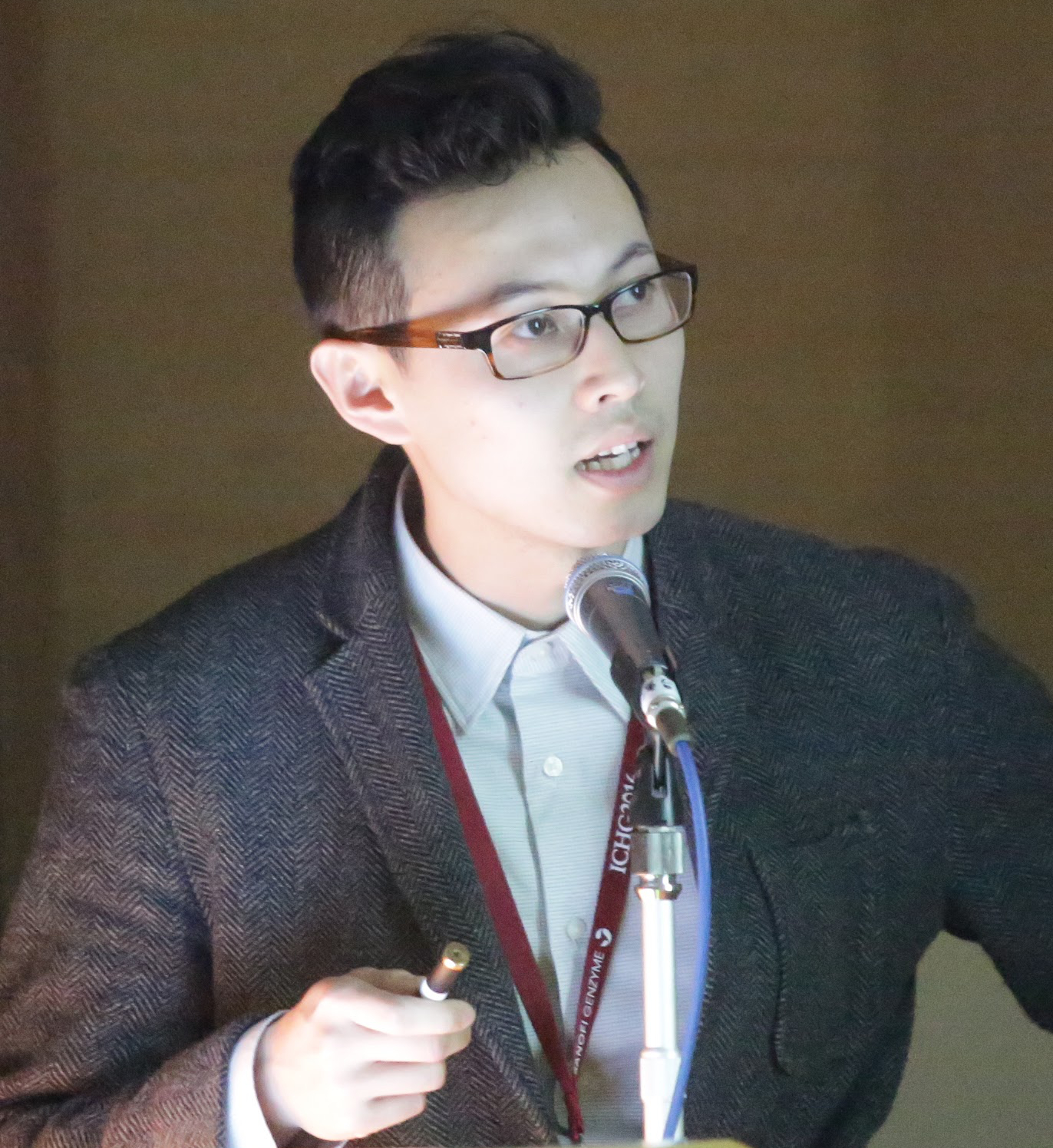
Yang I Li, DPhil
Yang is an Associate Professor in the Section of Genetic Medicine. He grew up in China, Belgium, and Canada. He obtained a B.Sc. in Mathematics and Computer Science from McGill University (2009), a M.Phil. in Biological Sciences from the University of Liverpool (2010), and a D.Phil. in evolutionary genomics from the University of Oxford (2014). He worked with Jonathan Pritchard at Stanford before moving to UChicago in 2017.
Outside lab he likes to hike, rock climb, cook, and travel.
Alumni16 people
| Name | Role | Years | Now |
|---|---|---|---|
| Ben Fair, PhD | Postdoc, then Staff Scientist | 2018–2026 | Staff Scientist, Hastings Lab, University of Michigan (from Nov 2026); ongoing collaborator |
| Sara Fritz, B.S. | Research Lab Technician | 2024–2026 | Research Technician, Ober Lab |
| Carlos Buen Abad, PhD | Postdoc | 2021–2026 | Assistant Professor, Clemson University |
| Fabio Morgante, PhD | Postdoc | 2018–2020 | Assistant Professor, Clemson University |
| Phoenix (Zepeng) Mu, B.S. | PhD Student | 2019–2024 | Postdoc, Harvard |
| Ankeeta Shah, B.A. | PhD Student | 2018–2023 | Piper Sandler |
| Chao Dai, B.S. | PhD Student | 2021–2025 | |
| Gabriela Mossian, B.A. | Lab Technician | 2021–2023 | |
| Eric Chen, B.S. | Research Assistant | 2021–2023 | PhD student, Harvard |
| Yi Zeng, PhD | Postdoc | 2021–2022 | Assistant Professor, University of Colorado Boulder |
| Austin Reilley | Lab Technician | 2020–2021 | |
| Stephanie Lozano, B.S. | Lab Technician | 2018–2020 | UC Davis Neuroscience |
| Tony Zeng, B.S. | Undergraduate | 2018–2021 | PhD student, Stanford Genetics |
| Shane Warland | Undergraduate | 2018–2021 | PhD student, Cornell |
| Henry Bloom | Undergraduate | 2022–2024 | |
| Alex Williams | Undergraduate | 2023–2024 |
A decade of work on splicing, regulation, and complex traits.
2026
- Depleting prion protein using splice-switching small moleculesLiu B, Fair B, Kuang Z, Tang Z, Zhao J, Zhou L, Kong Q, Solanki A, Kenny C, Mastrianni JA, Zhao R, Li YI, Wang JbioRxivPreprint
- Impact of disease-associated chromatin accessibility QTLs across immune cell types and contextsMu Z, Randolph HE, Aguirre-Gamboa R, Ketter E, Dumaine A, Locher V, et al.Cell Genomics
- Protein–protein interactions shape trans-regulatory impact of genetic variation on protein expression and complex traitsLi J, Li YI, Liu XNature Genetics
2025
- Integrative multi-omics QTL colocalization maps regulatory architecture in aging human brainCao X, Sun H, Feng R, Mazumder R, Buen Abad Najar CF, Li YI, et al.medRxivPreprint
- Genetic and functional analysis of unproductive splicing using LeafCutter2Buen Abad Najar CF, Feng R, Dai C, Fair B, Hauck Q, Li J, Cao X, Dey KK, et al.bioRxivPreprint
2024
- Global impact of unproductive splicing on human gene expression levelsFair BJ, Buen Abad Najar CF, Zhao J, Lozano S, Reilly A, Mossian G, Staley JP, Wang J, Li YINature Genetics
- Genetic and molecular architecture of complex traitsLappalainen T, Li YI, Ramachandran S, Gusev ACell
- Epigenetic variation impacts individual differences in the transcriptional response to influenza infectionAracena K et al.Nature Genetics
2023
- Genetics of sexually dimorphic adipose distribution in humansHansen GT et al.Nature Genetics
- Molecular quantitative trait lociAguet F, Alasoo K, Li YI, Battle A, Im HK, Montgomery SB, Lappalainen TNature Reviews Methods Primers
2022
- Profiling lariat intermediates reveals genetic determinants of early and late co-transcriptional splicingZeng Y, Fair BJ, Zeng H, Krishnamohan A, Hou Y, Hall JM, Ruthenburg AJ, Li YI*, Staley JP*Molecular Cell
- RNA editing underlies genetic risk of common inflammatory diseasesLi Q et al.Nature
- Predicting RNA splicing from DNA sequence using PangolinZeng T, Li YIGenome Biology
2021
- Haplotype-resolved diverse human genomes and integrated analysis of structural variationEbert et al.Science
- Benchmarking sequencing methods and tools that facilitate the study of alternative polyadenylationShah A, Mittleman B, Gilad Y, Li YIGenome Biology
- Impact of cell-type and context-dependent regulatory variants on human immune traitsMu Z, Wei W, Fair B, Miao J, Zhu P*, Li YI*Genome Biology
- Alignment of single-cell RNA-seq samples without over-correction using kernel density matchingChen M, Zhan Q, Mu Z, Wang L, Zheng Z, Miao J, Zhu P*, Li YI*Genome Research
2020
- Alternative polyadenylation mediates genetic regulation of gene expressionMittleman B, Pott S, Warland S, Zeng T, Mu Z, Kaur M, Gilad Y, Li YIeLife
2019
- Trans effects on gene expression can drive omnigenic inheritanceLiu X*, Li YI*, Pritchard JK*Cell
- Prioritizing Parkinson's Disease genes using population-scale transcriptomic dataLi YI*, Wong G*, et al.Nature Communications
2018
- Annotation-free quantification of RNA splicing using LeafCutterLi YI*, Knowles DA*, Humphrey J, Barbeira AN, Dickinson SP, Im HK, Pritchard JKNature Genetics
2017
- An expanded view of complex traits: from polygenic to omnigenicBoyle EA*, Li YI*, Pritchard JK*Cell
2016
- RNA splicing is a primary link between genetic variation and diseaseLi YI, van de Geijn B, Raj A, Knowles DA, Petti A, Golan D, Gilad Y, Pritchard JKScience
We want people who can design the experiment, not just analyze it.
We're building a loop between computation, experiment, and the clinic: models that propose splicing interventions, experiments that test them, and the patients with rare splice variants they're for. We're especially looking for people who want to work across that loop. We always have funding for exceptional applicants.
Postdoctoral fellows
Experimental and translational scientists in RNA biology, antisense or small-molecule splicing modulators, or disease-relevant cell models. Also computational scientists who want to design experiments and direct AI tools, not only build methods.
PhD students
Join through Genetics, Genomics & Systems Biology (GGSB), Human Genetics, or Computational Biology at UChicago. Students who want to combine computation with bench work are especially welcome.
Research scientists
Bench scientists who want to run high-throughput perturbation screens, such as ASO tiling or variant-by-modulator screens, in close collaboration with the computational side of the lab.
What you can expect from me
- Identification and creation of career-advancing opportunities
- Weekly meetings to discuss research and exchange ideas
- Support designing focused projects for timely publication
- Help interpreting results and prioritizing next steps
- Editing and feedback on grants and written materials
- Annual career development plan reviews
- Attendance at 1–2 conferences per year
- Training in experimental design and mechanistic biology, not just analysis
- Involvement in clinical collaborations around rare splice variants
- Hands-on experience with the lab's AI-driven analysis workflows, including where they fail
What I expect from you
- Conduct yourself with the utmost scientific integrity
- Maintain sustainable, reproducible code for data analysis
- Read approximately 5 papers a week
- Attend lab meetings, with advance notice if absent
- Actively pursue external funding and grant applications
- Be in lab at least 4 days a week, 10am–5pm
- Identify and apply for all relevant external funding opportunities
- Think in experiments: what result would change your mind?
- Use AI tools critically: verify outputs, and don't outsource your judgment